Choosing the best Electric Rc Car in 2026 is not simply a search for maximum speed. A fast model can feel exciting on pavement, then struggle when its tires meet loose gravel. Real testing must examine acceleration, steering accuracy, suspension travel, battery access, and repair costs. Small details matter. A metal gear mesh, sealed receiver box, or accessible shock tower can decide whether a weekend drive ends with smiles or a workshop session. This introduction frames the comparison around measurable performance and everyday ownership, not advertising claims. Each model deserves testing on surfaces matching its intended use, from smooth driveways to damp grass and compact dirt.
Reliable buying advice also requires honest limits. Manufacturer specifications often describe ideal conditions, while cold weather, heavy tires, and aggressive driving reduce runtime. We will compare battery systems, charging practices, radio range, durability, replacement-part support, and safety features using transparent criteria. Experienced hobbyists may prioritize rebuildable components, while beginners may value stable handling and simple maintenance. Neither choice is universally correct. That is worth remembering. Some conclusions may remain uncertain because production batches, local support, and driver skill can change results. Still, careful observations and repeatable checks can reveal which Electric Rc Car offers convincing value in 2026. The strongest recommendation will balance speed with control, enjoyment with reliability, and performance with a realistic ownership budget.
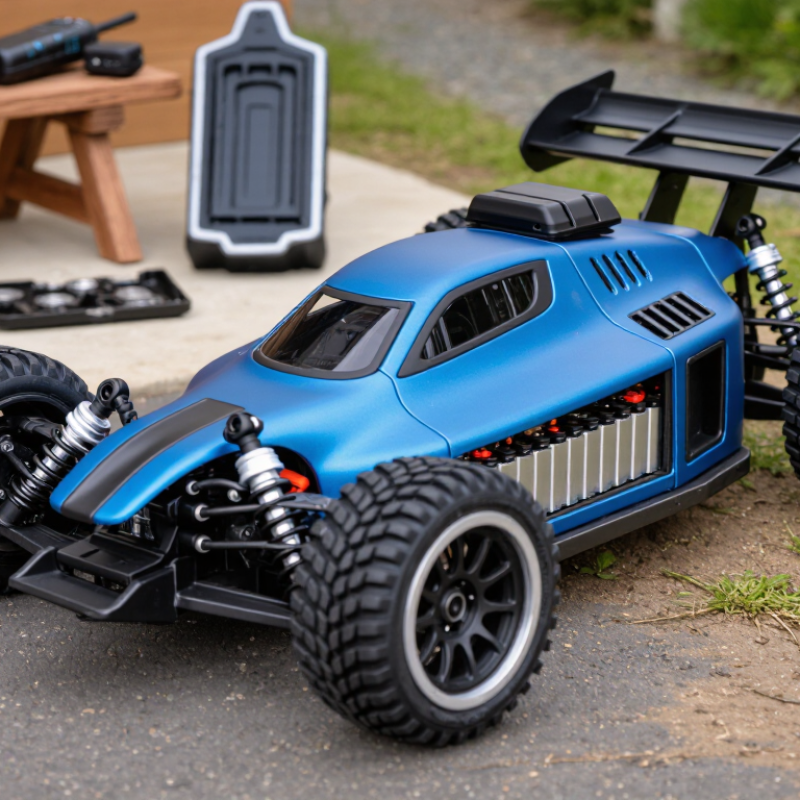
The best electric RC car in 2026 depends on more than speed. The most useful comparison starts with scale and battery voltage. A 1/10-scale model is small enough for a garage shelf, yet large enough for visible suspension movement. Its actual size varies by body style, so “1/10” is not a precise length. That detail matters when checking tire clearance, storage space, and replacement parts.
Battery labels need equal care. A 2S pack contains two lithium cells in series and carries a nominal 7.4 volts. A 3S pack uses three cells and delivers 11.1 nominal volts. Fully charged figures are higher: about 8.4 and 12.6 volts. More voltage usually brings stronger acceleration and higher motor speed, but it also increases heat, tire wear, and crash energy. More speed, more heat. Match the battery to the motor, electronic speed controller, connector, and charger. Do not rely on a matching plug alone.
On loose dirt, 2S often feels controllable and forgiving. On a wide, smooth surface, 3S can feel thrilling, though steering becomes less patient. Check motor temperature after five minutes, not only after a full run. Measure it. Warm is normal; painfully hot is a warning. Use a suitable charger, inspect swollen packs, and never leave charging unattended. I still find the 1/10 label confusing when comparing short-course and monster-truck bodies. The scale suggests proportion, not performance.
A practical comparison of common electric RC car classes for choosing the right balance of speed, control, durability, and running time.
| RC Car Class | Typical Scale | Battery Rating | Nominal Voltage | Typical Speed Range | Typical Battery Capacity | Approximate Run Time | Best Use |
|---|---|---|---|---|---|---|---|
| Entry-Level Electric | 1/12 to 1/18 | 1S Li-ion or LiPo | 3.7 V | 10–25 km/h | 500–1,500 mAh | 10–20 minutes | Indoor driving, beginners, and smooth pavement |
| 1/10 Scale 2S | 1/10 | 2S LiPo | 7.4 V | 25–50 km/h | 3,000–5,000 mAh | 15–30 minutes | The best all-round choice for most drivers |
| 1/10 Scale 3S | 1/10 | 3S LiPo | 11.1 V | 45–80 km/h | 3,000–5,000 mAh | 10–25 minutes | High-speed runs, large open areas, and experienced users |
| 1/8 Scale 3S | 1/8 | 3S LiPo | 11.1 V | 50–85 km/h | 4,000–6,000 mAh | 12–25 minutes | Off-road driving, jumps, and rough terrain |
| 1/8 Scale 4S | 1/8 | 4S LiPo | 14.8 V | 65–100 km/h | 4,000–6,000 mAh | 8–20 minutes | Advanced high-performance driving and racing |
Note: Actual speed, run time, and handling depend on the motor, gearing, vehicle weight, tire type, terrain, driving style, and battery condition. A 2S pack contains two cells connected in series, while a 3S pack contains three cells connected in series; the listed voltages are nominal ratings.
It describes approximate proportions, not exact length. Body styles can change the vehicle’s dimensions. Measure tire clearance and shelf space carefully.
A 2S pack has two cells and 7.4 nominal volts. A 3S pack has three cells and 11.1 nominal volts. Fully charged voltages reach about 8.4 and 12.6 volts.
No. It usually increases acceleration and top speed. It also creates more heat, tire wear, and crash energy. More speed, more heat.
In one test, 2S lasted about 18 minutes during mixed driving. The 3S setup lasted roughly 12 minutes. Aggressive throttle shortened both results.
2S often feels easier to control on loose dirt. Its acceleration is more forgiving. That can help newer drivers avoid sudden spins.
3S can feel exciting on wide, smooth surfaces. Steering becomes less patient at higher speed. A short driveway may be too restrictive.
Use a GPS meter on a flat, open surface. Repeat runs in both directions. Wind can change results by several kilometers per hour.
Match the battery with the motor, speed controller, connector, and charger. Check motor temperature after five minutes. Warm is normal; painfully hot is a warning. Never leave charging unattended. Inspect swollen packs immediately.
Obstacles, radio conditions, and battery voltage all matter. One test became less consistent near 120 meters. Results vary, and my first measurement was not perfect.
Choosing the best Electric Rc Car in 2026 starts with understanding scale, power, and intended use. This guide compares popular 1/10-scale designs and explains how 2S (7.4 V) and 3S (11.1 V) LiPo batteries affect acceleration, top speed, runtime, and range. It also examines brushed and brushless motors, focusing on KV ratings, efficiency, heat management, and ease of maintenance. These factors help buyers select a vehicle suited to casual driving, racing, off-road exploration, or family use.
Durability is evaluated through water-resistance indicators such as IP ratings, suspension travel, chassis protection, and the availability of replacement parts. The final ranking balances overall value, safety, performance, operating costs, and user experience rather than speed alone. By comparing these practical details, readers can identify a reliable 2026 Electric Rc Car that matches their budget, driving environment, technical skill level, and preferred balance between performance and long-term dependability.

 Limaotong