2026 Best Electric Bicycle Types for Global Buyers

Time:2026-09-21 Author:Mason
0%

Choosing the right Electric Bicycle in 2026 requires more than comparing motor power or glossy product photos. Global buyers face different roads, climates, budgets, and local safety requirements. A compact folding model may suit a crowded apartment and train commute. A cargo e-bike can carry groceries, tools, or two children. Mountain models offer stronger control on uneven trails, while city bicycles prioritize comfort, lighting, and practical storage.

Real-world performance depends on details that specifications often hide. A larger battery may add useful range, but it also increases weight. Wider tires can improve grip on wet streets, yet they may feel slower on smooth pavement. Riders should check frame size, brake quality, charging standards, replacement parts, and service access before purchasing. Test rides reveal awkward handlebars, noisy motors, or uncomfortable saddles quickly. Online reviews still help, but they may reflect one climate, one rider, or one short ownership period.

Small differences matter.

This guide compares the leading Electric Bicycle types for global buyers, using practical riding experience, manufacturer information, and established safety guidance. It considers commuting, recreation, delivery work, family transport, and long-distance touring. However, no category is perfect. Battery range changes with hills, temperature, rider weight, tire pressure, and cargo. Marketing claims can also sound more certain than real roads allow. Careful buyers should verify regional requirements and warranty terms before ordering. The best choice is not always the fastest model. It is the bicycle that fits daily habits, local conditions, maintenance skills, and honest expectations.
2026 Best Electric Bicycle Types for Global Buyers

What Defines an Electric Bicycle in 2026

What Defines an Electric Bicycle in 2026

An electric bicycle combines human pedaling with a rechargeable motor system. Its identity depends on more than a battery. A buyer should inspect motor assistance, maximum assisted speed, rated power, controls, and braking performance. In Europe, an EPAC generally supports pedaling up to 25 km/h, with a motor rated at no more than 250 watts. Other regions use different classifications, so one label cannot describe every market.

The numbers show why this category matters. The International Energy Agency’s Global EV Outlook 2024 reported that electric two- and three-wheelers represented nearly 60% of global sales in 2023. That wider category includes many lightweight vehicles, not only bicycles. CONEBI’s 2024 European Bicycle Industry and Market Profile recorded about 5.1 million e-bikes sold across Europe in 2023. Demand is real, but definitions remain uneven.

Look closely at the riding experience. A 250-watt system may feel smooth on a flat cycle lane, yet weak on a steep road with luggage. Battery capacity also needs context. A 500 Wh battery does not promise one fixed distance, because temperature, rider weight, tire pressure, and hills change consumption. Displayed range can disappoint. Buyers should request test data, service information, charger safety details, and local compliance evidence. Some specifications still look impressive but explain little. That is a problem worth admitting.

How Electric Bicycle Types Differ by Design and Use

Electric bicycle types differ mainly by frame geometry, motor placement, battery position, and intended riding surface. City models usually have upright handlebars, narrow tires, integrated lights, and practical racks. They suit paved streets, short commutes, and frequent stops. A step-through frame can make mounting easier, especially when carrying groceries or wearing work clothes.

Mountain-oriented electric bicycles use wider tires, stronger suspension, and more responsive braking systems. Their frames feel stable on gravel, roots, and steep paths, but they can feel slow on smooth roads. Folding models use smaller wheels and hinges for storage in apartments, trains, or car trunks. I have found them convenient, though some designs feel less steady at higher speeds. That trade-off deserves a test ride.

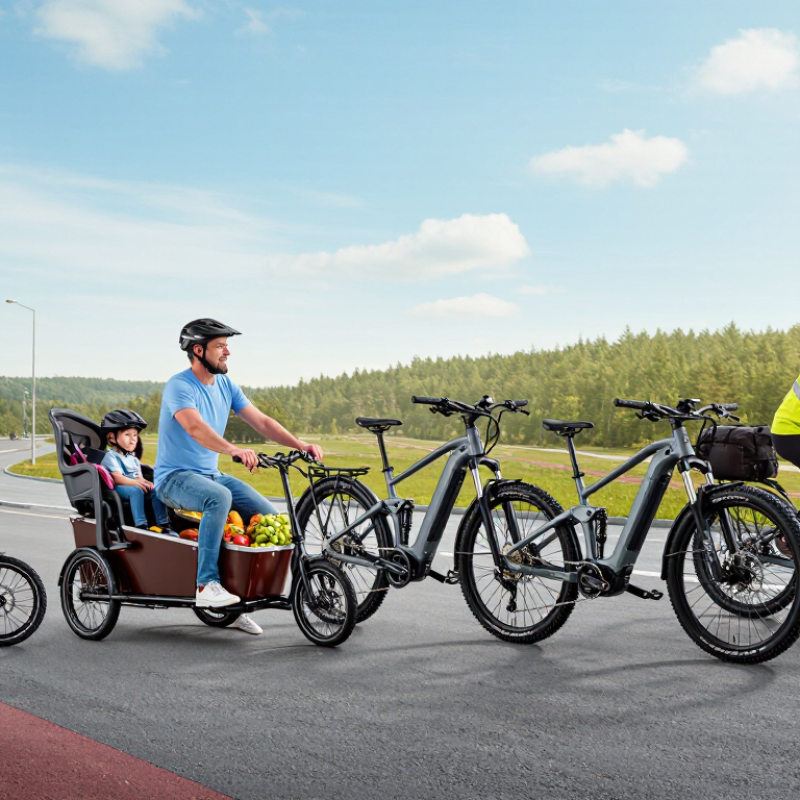
Cargo bicycles are built around carrying capacity. Their extended frames, reinforced wheels, and low centers of gravity help transport children, parcels, or shopping. Compact cargo designs work well in crowded neighborhoods, while long-tail versions offer more space but require wider turning angles. Road-focused electric bicycles usually keep drop handlebars and lightweight frames. They are efficient over distance, but their riding position may feel demanding for beginners.

Motor location also changes the experience. Hub motors deliver smooth assistance on flat roads. Mid-drive systems often climb hills more naturally and use the bicycle’s gears effectively. However, specifications alone can mislead. Check real weight, brake quality, battery removal, and local service access. A bicycle that looks perfect online may feel awkward after ten minutes on an uneven road.

Key Electric Bicycle Categories for Global Buyers

For global buyers, electric bicycles are best understood by use case, not appearance. City and commuter bicycles suit paved streets, daily errands, and moderate distances. Their upright positions, integrated lights, and practical racks help during crowded mornings. A step-through frame can make frequent stops easier. Check battery capacity against hills, rider weight, wind, and winter temperatures. Range figures are often tested under gentle conditions. Real roads disagree.

Folding electric bicycles serve apartment residents, train commuters, and travelers with limited storage. Smaller wheels feel responsive, but rough roads may transmit more vibration. Cargo bicycles are built for groceries, children, tools, or small business deliveries. Their longer frames need wider turning space and stronger parking support. Mountain and off-road models use wider tires, suspension, and stronger braking systems. They require more maintenance after mud, dust, or steep descents. Road-oriented electric bicycles are lighter and faster on smooth pavement, yet narrow tires demand attention on broken surfaces.

In practical inspections, I compare motor placement, brake feel, charger quality, frame strength, and replacement-part access. Mid-drive systems often climb naturally, while hub motors can feel simple and predictable. Neither choice is perfect. Local service availability matters as much as advertised power. Buyers should verify charging compatibility, safety documentation, warranty terms, and weather limits for their destination. I have seen attractive specifications hide uncomfortable saddles and awkward controls. A short test ride reveals details that a product page cannot.

2026 Best Electric Bicycle Types for Global Buyers

Key electric bicycle categories compared by their commonly defined maximum assisted speed

Lower-speed pedelecs and city e-bikes are generally suited to everyday commuting, while higher-speed categories are designed for longer journeys and may require registration, insurance, licensing, or additional safety equipment depending on local regulations. EU EPAC limits assistance to 25 km/h, while U.S. Class 1 and Class 2 categories are commonly limited to 20 mph and Class 3 to 28 mph.

How to Match Bicycle Types With Riding Needs and Local Conditions

2026 Best Electric Bicycle Types for Global Buyers

Matching an electric bicycle to real riding conditions matters more than chasing the newest specifications. CONEBI’s 2024 European Bicycle Industry and Market Profile reported about 5.1 million e-bikes sold in Europe during 2023. That demand covers very different daily journeys.

A city or trekking e-bike suits paved commutes, moderate distances, and frequent stops. Choose a step-through frame when clothing, balance, or heavier loads affect confidence.

Rain changes everything. For wet climates, check sealed electrical components, dependable brakes, full mudguards, and corrosion-resistant hardware.

A 500 Wh battery is not a universal answer. Hills, rider weight, tire pressure, temperature, and cargo can reduce practical range.

Cargo bicycles work well for groceries, children, and small business deliveries, but their longer frames need wider parking space. Compact folding models suit apartments, trains, and short last-mile trips.

Mountain e-bikes need stronger wheels, hydraulic braking, and controlled suspension on rough trails. Fat-tire versions can improve stability on sand or snow, though they often consume more energy.

The IEA’s Global EV Outlook 2024 identifies electric two- and three-wheelers as the most electrified road transport segment, reinforcing the importance of efficient lightweight mobility.

Local rules still decide usable power, speed limits, lighting, and helmet requirements. Verify them before buying.

My first recommendation can be wrong if I ignore storage, repair access, or winter temperatures.

Test the loaded bicycle on a real hill, not only inside a showroom.

Weight matters. Range estimates need skepticism.

Essential Buying Factors for Comparing Electric Bicycles

When comparing electric bicycles in 2026, begin with riding conditions, not motor size. The IEA’s Global EV Outlook 2024 identifies electric two- and three-wheelers as the largest electric road-transport segment by sales. That signals strong demand, but market growth does not guarantee a suitable bicycle.

Battery capacity matters more than advertised range. Compare watt-hours, charging time, battery replacement cost, and performance on hills. A 500 Wh battery may feel adequate on flat roads but less impressive with cargo, cold weather, or frequent climbs. Independent tests often use different rider weights and routes, so range figures are not directly comparable. Real-world checking is essential.

Motor torque should match the terrain and load. Riders in hilly areas may value 60–80 Nm, while urban commuters can often use less. Check frame size, brake performance, tire width, lighting, and water resistance before focusing on display features. The European Commission’s JRC research on light electric mobility emphasizes safety, infrastructure, and user behavior as important adoption factors. Look for recognized electrical and battery safety testing, such as EN 15194 or UL 2849 where applicable. Certification is useful, not magical. Service access, spare parts, warranty terms, and local charging conditions can decide long-term value. I would also calculate total ownership cost over three years, because a cheaper purchase can become expensive after one battery replacement.

2026 Best Electric Bicycle Types for Global Buyers - Essential Buying Factors for Comparing Electric Bicycles

Electric Bicycle Type Best Use Typical Motor Output Common Battery Capacity Typical Assisted Range Typical Wheel and Tire Setup Common Frame Features Key Buying Factors Main Trade-Off
City / Commuter E-Bike Daily urban travel, paved roads, errands and commuting 250–500 W nominal 400–625 Wh 40–100 km 26–28 in wheels; 35–55 mm tires Upright riding position, integrated lights, mudguards, rear rack and chain guard Legal power limit, comfortable geometry, hydraulic or mechanical disc brakes, theft-resistant battery and rack capacity Usually less suitable for rough trails or steep off-road terrain
Electric Road Bike Fast paved-road riding, fitness and long-distance touring 250–500 W nominal 250–500 Wh 50–140 km 28 in / 700C wheels; 28–40 mm tires Lightweight frame, drop handlebar, narrow tires and low aerodynamic riding position Total weight, battery integration, motor drag when unassisted, gear range and tire puncture protection Less comfort and traction on broken pavement, gravel or mud
Electric Mountain Bike Forest trails, climbs, mixed terrain and recreational off-road riding 250–750 W nominal 500–750 Wh 30–80 km 27.5 or 29 in wheels; 2.2–2.6 in knobby tires Suspension fork or full suspension, wide-range gears, dropper-post compatibility and reinforced frame Suspension travel, hydraulic brake rotor size, torque delivery, water resistance and replacement-part availability Heavier, more expensive and less efficient on smooth roads
Electric Cargo Bike Carrying children, groceries, parcels and work equipment 250–750 W nominal 500–1,000 Wh 30–80 km 20–26 in wheels; wide, load-rated tires Long-tail or front-load platform, reinforced frame, strong kickstand and passenger or cargo mounts Maximum permitted load, frame stability, low-speed handling, brake performance, battery options and parking size Large footprint and lower maneuverability when heavily loaded
Electric Folding Bike Apartment living, public-transport connections, travel and limited storage 250–500 W nominal 250–500 Wh 25–75 km 16–20 in wheels; approximately 1.75–2.25 in tires Hinged folding frame, adjustable stem and seatpost, compact wheelbase and carrying handle Folded dimensions, hinge security, carry weight, battery removal and compatibility with transport rules Small wheels can feel less stable over potholes and usually provide less cargo capacity
Electric Fat-Tire Bike Sand, snow, loose gravel and stable recreational riding 500–750 W nominal 500–960 Wh 30–80 km 20 or 26 in wheels; 4.0–5.0 in tires Very wide tires, rigid or front-suspension fork and high-clearance frame Tire pressure range, motor cooling, wheel weight, brake power and availability of replacement tubes or tires High rolling resistance, substantial weight and reduced efficiency on paved roads
Electric Hybrid / Trekking Bike Mixed commuting, paved paths, light gravel and touring 250–500 W nominal 400–750 Wh 45–120 km 27.5 or 28 in wheels; 40–60 mm tires Flat handlebar, moderate suspension, rack and mudguard mounts, multiple riding modes Riding position, gear range, rack load rating, battery size, comfort and service support Not as fast as a road bike or as capable as a dedicated mountain bike
Electric Tricycle Low-speed stability, mobility support and bulky-load transport 250–750 W nominal 400–960 Wh 25–75 km 20–26 in front wheel; 16–24 in rear wheels Three-wheel platform, low step-through frame, rear or front cargo area and parking brake Turning behavior, width, maximum load, reverse or walk-assist function, brake design and storage access Wider turning circle and different cornering behavior than a two-wheel bicycle
Data note: Specifications are typical market ranges rather than universal limits. Assisted range depends on rider and cargo weight, terrain, wind, temperature, tire pressure, assist level, riding speed and battery age. Buyers should confirm local rules for motor rating, maximum assisted speed, throttle use, lighting, helmets and road access before purchase.

FAQS

How does a city electric bicycle differ from a mountain model?

City models use upright handlebars, narrow tires, racks, and integrated lights. They suit paved streets and frequent stops. Mountain models use wider tires, suspension, stronger wheels, and sharper brakes. They feel safer on gravel, roots, and steep paths. They may feel slow on smooth roads.

When is a step-through frame useful?

A step-through frame makes mounting easier. It helps riders wearing work clothes or carrying groceries. It can also improve confidence when balance feels uncertain. Still, frame strength and correct sizing matter more than easy access alone.

Are folding electric bicycles suitable for daily travel?

Folding models fit apartments, trains, and car trunks. Smaller wheels make storage easier. They can feel less stable at higher speeds. A short test ride matters. Check the folded size and lifting weight before buying.

Which electric bicycle type works best for carrying children or groceries?

Cargo bicycles use reinforced wheels, extended frames, and low centers of gravity. They can carry children, parcels, or shopping. Compact versions suit narrow streets and limited parking. Long-tail versions offer more space but need wider turns. Measure your storage area first.

Should riders choose a hub motor or a mid-drive motor?

Hub motors provide smooth assistance on flat roads. Mid-drive motors often climb hills more naturally. They also use the bicycle’s gears effectively. Motor specifications can mislead. A heavily loaded bicycle may still feel difficult uphill.

How should battery capacity be judged?

Compare watt-hours, charging time, replacement cost, and hill performance. A 500 Wh battery is not a universal answer. Cargo, cold weather, hills, low tire pressure, and rider weight reduce range. Range estimates deserve skepticism. Real roads are less polite.

What should buyers check for wet climates?

Look for sealed electrical components, dependable brakes, full mudguards, and corrosion-resistant hardware. Wet roads increase braking demands. Check whether the battery removes easily for indoor charging. A shiny finish does not prove weather resistance.

What features matter most on rough trails?

Mountain-oriented bicycles need strong wheels, controlled suspension, wide tires, and responsive braking. Fat tires can improve stability on sand or snow. They often consume more energy. Suspension setup also affects comfort and control.

How do local conditions affect the buying decision?

Local rules may determine permitted power, speed limits, lights, and helmet requirements. Repair access matters too. Check nearby service options and spare-part availability. I might recommend the wrong bicycle if I ignore winter temperatures or storage space.

What is a practical way to test an electric bicycle?

Test it on an uneven road, a real hill, and a tight turn. Add the usual cargo if possible. Check braking, steering, battery removal, and parking width. Ten showroom minutes may reveal little. The first choice can still be imperfect.

Conclusion

Choosing the right Electric Bicycle in 2026 begins with understanding how modern models combine pedal assistance, battery power, motor output, and practical control systems. Electric bicycles now come in many forms, including city commuters, folding designs, mountain models, cargo bikes, road-oriented bicycles, and utility-focused options. Each type is built for a different balance of comfort, speed, carrying capacity, terrain handling, and storage convenience.

For global buyers, the best choice depends on daily riding needs and local conditions. Consider road quality, climate, hills, travel distance, parking space, and whether the bicycle will be used for commuting, exercise, family transport, or recreation. Important comparison factors include battery range, charging time, motor performance, frame design, braking quality, tire type, weight, riding position, durability, maintenance requirements, and available safety features. Buyers should also confirm that the selected model meets applicable local requirements before purchase.


Mason

Mason

Mason is a seasoned marketing professional with a deep expertise in the company's offerings and a passion for driving brand awareness. With a strong background in digital marketing strategies, he has an innate ability to connect with diverse audiences and effectively communicate product benefits.......